
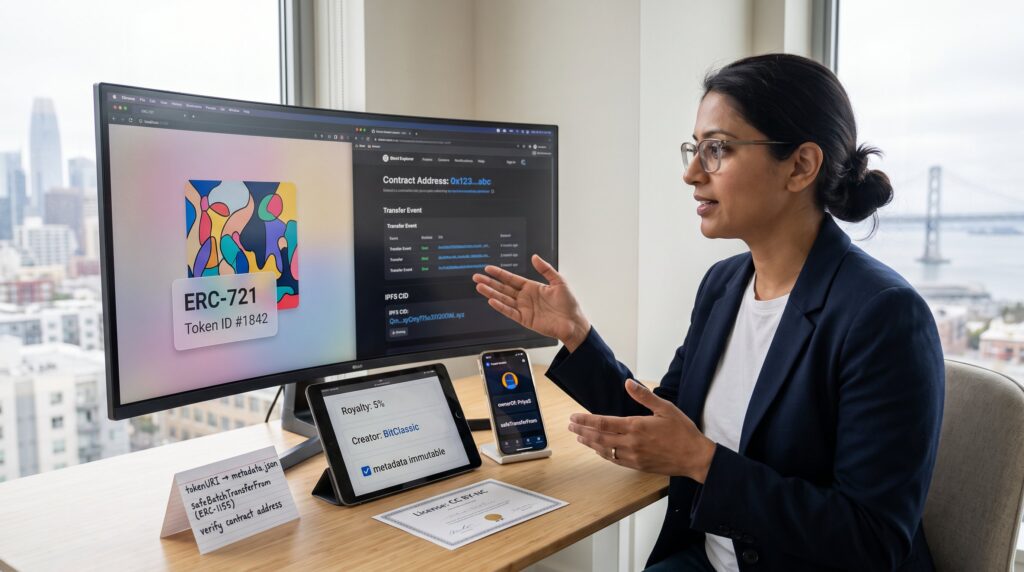
BitClassic Explains NFTs, Digital Ownership, and Token Standards opens a practical door into what NFTs are and why they matter in 2026. The piece gives a direct answer: NFTs are unique blockchain tokens that prove ownership and provenance for a digital or physical item. Readers will find clear steps for buying, storing, and verifying tokens, plus a plain-language comparison of token standards like ERC-721 and ERC-1155. The goal is immediate utility: know how ownership is recorded, which standard fits a use case, and which checks to run before a purchase.
Table of Contents
ToggleKey Takeaways
- NFTs are unique blockchain tokens that prove digital or physical ownership and enable verifiable provenance.
- Token standards like ERC-721 and ERC-1155 ensure interoperability across wallets and marketplaces, supporting different use cases.
- Buying an NFT involves connecting a compatible wallet, verifying the contract address, and securely managing private keys, preferably with hardware wallets.
- Verification steps include checking the token contract, confirming on-chain ownership, and reading metadata to avoid fraud and counterfeit tokens.
- NFTs have broad applications, from art sales to tokenized real estate, but market volatility and platform risks require careful planning and risk management.
- Understanding and using the right token standard is essential for practical NFT deployment and digital ownership management.
What NFTs Are And Why They Matter
NFTs are unique blockchain tokens that link a distinct identifier and metadata to an asset. This single fact explains why they matter: they create a verifiable chain of ownership that travels with the token, not the file.
On a practical level, an artist can mint one digital painting as an NFT and buyers can trace each transfer on-chain. That traceability reduces disputes about provenance and lets marketplaces accept the token automatically. For businesses, NFTs let brands program royalties: in some collections, creators receive a 5–10% resale fee every time a token changes hands.
NFTs also let companies tokenize real-world items. For example, a property title can be represented by a token that points to legal records. More on this evolving use appears in BitClassic’s article about the future digital assets market, which shows how asset classes shift when ownership becomes programmable.
Practical warning: an NFT’s market value can swing wildly. Provenance is reliable: price is not.
NFT Token Standards And How They Enable Digital Ownership
Standards define how wallets and marketplaces interact with tokens. This matters because a shared interface makes tokens portable across apps and trade venues. Ethereum standards like ERC-721 and ERC-1155 give developers predictable rules for minting, transferring, and querying ownership.
Ethereum’s smart-contract capabilities and history shape these standards: the protocol’s move to proof-of-stake and its contract model are central reasons developers use Ethereum-compatible token interfaces. For a concise primer on Ethereum’s capabilities, Investopedia’s Ethereum page.
BitClassic has explored how tokens evolve in pieces such as sfts and nfts that highlight why standards must adapt when tokens mix fungible and non-fungible roles.
Practical Uses, Risks, And How To Buy, Store, And Verify NFTs
NFTs power art sales, in-game economies, event tickets, loyalty rewards, and tokenized real estate. That one statement captures the broad utility and motivates why organizations experiment with tokenization.
To buy an NFT, users connect a compatible wallet to a marketplace, confirm the contract address, and sign a purchase transaction. For storage, control the private key: hardware wallets remain the safest option for long-term holdings. BitClassic’s piece on the expanding universe of nfts shows concrete cases where tokens map to physical deeds or concert access.
Verification requires three checks: confirm the token contract address, validate the token ID against on-chain ownership, and read metadata to confirm what the token points to. Use block explorers to trace transfers and detect suspicious minted copies.
Risks are real: market volatility, phishing, smart-contract bugs, and off-chain metadata loss. Investor guidance on token offerings explains regulatory and fraud risks: for investor alerts, consult the SEC bulletin on coin offerings.
A practical warning from teams: when a marketplace delists a collection, liquidity can evaporate overnight. Plan exit strategies, verify secondary-market depth, and never store large balances on custodial platforms without clear terms.
Conclusion
NFTs change how ownership is represented: a token’s ledger entry proves control, standards make tokens portable, and careful processes reduce risk. Readers should treat standards like tools, ERC-721 for unique items, ERC-1155 when scale and batching matter, and follow verification steps before buying. BitClassic’s coverage offers next reads on market trends, token evolution, and real-world tokenization to help teams plan practical deployments.