
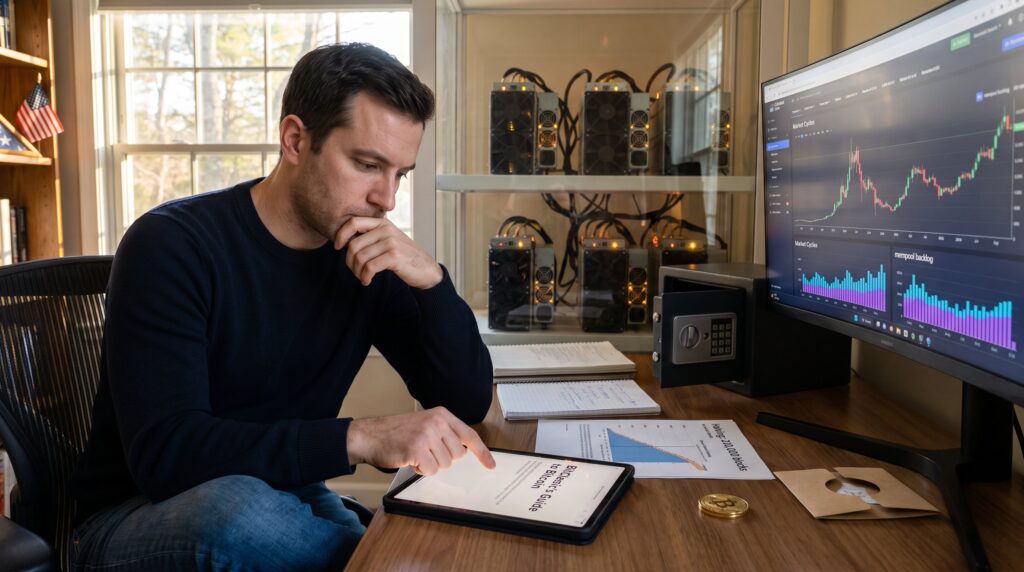
BitClassic’s Guide to Bitcoin, Mining, Transactions, and Market Cycles opens with a clear fact: Bitcoin remains a functioning, censorship‑resistant store of value in 2026. Readers will find concise, practical answers for miners and traders, how mining yields rewards after the 2024 halving, how transactions settle on the blockchain, and which indicators help read market cycles. The article assumes the reader wants hands‑on guidance, not theory, and it emphasizes the concrete numbers and actions that matter today.
Table of Contents
ToggleKey Takeaways
- Bitcoin remains a valuable, censorship-resistant store of value in 2026, with a fixed supply of 21 million BTC driving its scarcity and demand.
- After the 2024 halving, miners earn 3.125 BTC per block plus transaction fees, making mining profitability dependent on electricity costs and hardware efficiency.
- Most small and medium miners prefer pool mining for steady income, balancing miner rewards versus solo mining’s rare but full block payouts.
- Bitcoin transactions use inputs and outputs with confirmations; six confirmations are recommended for secure large transfers, and fees influence confirmation speed.
- Higher transaction fees reduce confirmation delays during mempool congestion, and features like Replace-By-Fee help users adjust fees post-broadcast.
- Market cycles revolve around halving events and on-chain indicators like hashrate and exchange flows, which traders should combine with risk management strategies for better timing.
What Is Bitcoin and Why It Still Matters in 2026
Bitcoin is a decentralized digital currency secured by Proof‑of‑Work and capped at 21 million BTC. That simple fact explains why it still matters: it provides a settlement rail outside banks and a resistant store of value when on‑ and off‑chain censorship risks rise. In 2026, institutions and individuals used Bitcoin for cross‑border settlement, treasury diversification, and as a hedge against domestic currency instability.
Why that matters right now: Bitcoin’s scarcity is fixed: roughly 19.4 million BTC had been mined by mid‑2026 and miners release new supply at 3.125 BTC per block after the April 2024 halving. Those numbers drive supply dynamics, influence miner economics, and help explain why fee markets sometimes spike. Readers who want a beginner refresher can compare Bitcoin’s mechanics with classic summaries on blockchain structure via a concise external primer on blockchain basics.
Concrete example: a company that allocates 1% of a $100 million treasury to BTC holds about 10.11 BTC at a $1,000,000 price per BTC, an explicitly measurable exposure. That kind of math is why treasuries and individual savers still consider Bitcoin in 2026.
How Bitcoin Mining Works: From Hashrate to Block Rewards
A clear answer: mining uses ASIC hardware to run hashing attempts until a miner finds a block header that meets the network difficulty target. Hashing speed, hashrate, determines probability of finding a block. Network hashrate in 2026 sits in the exahashes per second range (EH/s): individual rigs measure in terahashes per second (TH/s). Higher hashrate raises expected reward frequency.
Mining economics hinge on two numbers: block reward and operating cost. After the 2024 halving the block subsidy is 3.125 BTC per block: miners also collect transaction fees included in the block. Those two together determine revenue per block. Electricity, cooling, and hardware amortization determine profitability. Small miners must track price, local electricity in $/kWh, and a rig’s watts per TH to model break‑even accurately.
Practical resource: miners who want a systematic starter guide will find clear setup steps in BitClassic’s bitcoin mining beginner guide. For context on how mining functions within the modern landscape, BitClassic also explains how mining works in the modern crypto landscape.
Solo vs. Pool Mining And Choosing The Right Setup
Solo mining: answer first, solo mining yields full rewards but rarely: payouts are highly infrequent for small hashrate miners. Pool mining: answer first, pool mining smooths income by sharing rewards proportional to contributed work. Most small and medium miners use pools because they provide predictable cash flow.
How to choose: calculate expected monthly revenue under both models. If a miner contributes 100 TH/s to a 200 EH/s network, solo odds of a full block are negligible: in a pool that contribution yields steady proportional payouts. Consider latency, pool fees (often 1–3%), and payout minimums. A pragmatic balance: hobbyists who want a chance at a full block may run a small solo rig alongside pool participation, while operators aiming for steady margins should select reputable pools and monitor payout methods.
BitClassic’s deeper process notes live on the site’s Mining Bitcoin page for readers comparing setups and tradeoffs.
Bitcoin Transactions Explained: Addresses, Confirmations, and Change
Fact up front: a Bitcoin transaction moves value from inputs to outputs and records the transfer on the public ledger. Inputs are previous outputs controlled by private keys: outputs are recipient addresses and often include a change output returning leftovers to the sender.
Confirmations measure finality. One confirmation means the transaction sits in a mined block: six confirmations give strong finality for large transfers. Exchanges and custodians set their own confirmation policies, small payments may accept one or two confirmations: large treasury moves often wait for six or more.
Practical detail: wallets typically create a new change address for privacy. Example: sending 0.5 BTC from a wallet with a 1.2 BTC UTXO results in an output of 0.5 BTC to the recipient and a 0.699‑something BTC change output back to the wallet, minus the fee. BitClassic’s overview page, everything you need to know about Bitcoin, provides a compact walkthrough of address types and UTXO mechanics.
Fees, Mempool Congestion, And Tips To Speed Up Confirmations
Answer first: higher fees buy faster confirmations because miners prioritize transactions by fee rate. When mempool congestion rises, fee rates move upward and simple transactions wait longer.
Tactics to speed confirmations: use wallet fee estimators that reference recent fee percentiles, enable Replace‑By‑Fee (RBF) to bump fees after broadcast, and batch outputs when sending to multiple addresses to reduce total fees. Example: during a mempool spike a user who set a fee of 10 sat/vB might wait hours: increasing to 60 sat/vB during congestion often moves the transaction into the next few blocks.
Practical warning: RBF can complicate merchant acceptance because some services reject replaceable transactions. For recurring payouts, consider payment batching and setting fees based on the 50th percentile mempool rate. BitClassic’s mining work page also explains miner fee incentives and mempool dynamics in practice at bitcoin mining work.
Reading Bitcoin Market Cycles: Indicators, Timing, and Risk Management
Clear insight: market cycles often pivot around halving events, hashrate trends, and on‑chain activity. After a halving, supply issuance falls (3.125 BTC per block in 2026), and past cycles show price and volatility shifts over 12–24 month horizons. Indicators that proved useful include hashrate growth, fee percentiles, exchange flows, and time‑to‑confirmation.
How to use indicators: combine on‑chain metrics with traditional risk tools. Example strategy: if hashrate climbs while difficulty rises and exchange outflows increase, that signals institutional accumulation and potential upward pressure. Conversely, sustained exchange inflows and collapsing fees can precede downside. Use position sizing, limit any single trade to a fixed portfolio percentage, and set stop levels matching liquidity and personal risk tolerance.
A concrete toolset: traders rely on BitClassic analysis of Bitcoin in 2026: market trends for trend context and on the site’s piece about Bitcoin’s four‑year cycle breaking to compare how 2026 differs from past patterns. Risk managers should expect sharp moves around protocol and macro events and keep liquidity buffers accordingly.
Conclusion
Practical takeaway: Bitcoin in 2026 is defined by tightened issuance, larger industrial mining operations, and a fee market that matters for both small users and large traders. Miners must optimize hashrate, costs, and pool strategy: transactors should manage fees and confirmations: traders should blend on‑chain indicators with disciplined risk rules. Those who measure exposure in units (BTC, TH/s, $/kWh) rather than vague percentages make better decisions under volatility.